Choosing Trial Batches When Replacing Chemical Processing Steps
Replacing a chemical processing step with an enzyme-enabled alternative is not proven by a clean lab result alone. It is proven when the trial survives normal factory variation: raw material changes, shift timing, equipment behavior, hold times, cleaning windows, and operator routines.
For process improvement managers, the batch selection decision can determine whether a promising recommendation becomes a reliable production-floor improvement or a misleading one-off result.
Yieldwright Labs works as an industrial enzyme trial supplier for factories, structuring trials so plant teams can evaluate enzyme options under commercially relevant conditions before committing to wider change.
This article focuses on one practical question: which batches should you choose for a chemical replacement trial?
Why batch selection can distort trial results
A poorly chosen trial batch can make an enzyme route look better or worse than it really is.
Common problems include:
- Trialing only on unusually clean or uniform raw materials
- Choosing a production window with lower-than-normal throughput pressure
- Avoiding difficult seasonal or supplier variation
- Comparing an enzyme trial against an outdated or unrepresentative chemical baseline
- Running the trial on equipment that behaves differently from the main production line
- Selecting a batch because it is convenient rather than commercially meaningful
The result is a trial that answers the wrong question. Instead of learning whether the enzyme process can replace the chemical step in normal operation, the plant only learns whether it can work under a narrow and favorable condition.
A useful trial does not need to test every possible variable. It does need to test enough variation to support a confident go/no-go decision.
Start with the commercial decision the trial must support
Before selecting batches, define the decision the trial is meant to inform.
Examples:
- Can the enzyme route reduce chemical use without increasing rework?
- Can the process maintain target yield at existing line speed?
- Can the enzyme step fit within the current production window?
- Can operators run the new step without adding complexity or downtime?
- Can quality release criteria be maintained across representative feedstock variation?
Once the decision is clear, batch selection becomes more disciplined. You are not simply asking, “Can this enzyme work?” You are asking, “Can this enzyme-supported process perform under the conditions that matter to this factory?”
Define the baseline before choosing trial material
Chemical replacement trials should begin with a current-state baseline, not a memory of how the process usually performs.
A practical baseline should capture:
- Raw material source and specification range
- Batch size and production route
- Chemical addition points and timing
- Temperature and process hold conditions
- Throughput rate
- Yield or recovery
- Product quality indicators
- Rework, rejects, or off-spec events
- Cleaning or changeover impact
- Operator interventions
- Utility or consumable use where relevant
The baseline does not need to be overcomplicated. It does need to be tied to the same equipment, materials, and production context as the enzyme trial.
If the chemical step has high variability, capture that variability before running the enzyme comparison. A single strong baseline batch can create false confidence; a single weak baseline batch can exaggerate improvement.
Choose batches that represent normal factory variation
Representative does not mean average only. It means the selected trial batches reflect the range of conditions the enzyme route will face after implementation.
Include typical material
At least one trial batch should use raw material that reflects normal operating conditions. This becomes the practical comparison point for process fit.
Typical material helps answer:
- Does the enzyme route perform under standard feed conditions?
- Does it fit normal scheduling and equipment use?
- Are operators able to run the revised step without disruption?
- Are quality results comparable to the chemical process?
Include challenging but valid material
If the plant routinely handles material variation, the trial should include a controlled challenge case. This may include:
- Higher impurity load within accepted specification
- Seasonal raw material variation
- A supplier lot known to process differently
- Higher viscosity or solids behavior within normal acceptance limits
- A batch that historically requires closer process control
The purpose is not to force failure. The purpose is to understand the boundary between acceptable performance and unacceptable risk.
Avoid exceptional material unless the business case requires it
Do not anchor the main trial on unusual material unless that material represents a real production requirement.
Examples of poor trial choices include:
- A distressed batch selected only because it is available
- A rework-heavy batch with abnormal history
- A raw material lot outside normal acceptance limits
- A production run scheduled during maintenance disruption
- A small batch that does not reflect full-scale mixing or residence behavior
If exceptional material must be tested, treat it as a separate stress case, not the basis for the main decision.
Match the trial window to real production constraints
Trial timing matters as much as trial material.
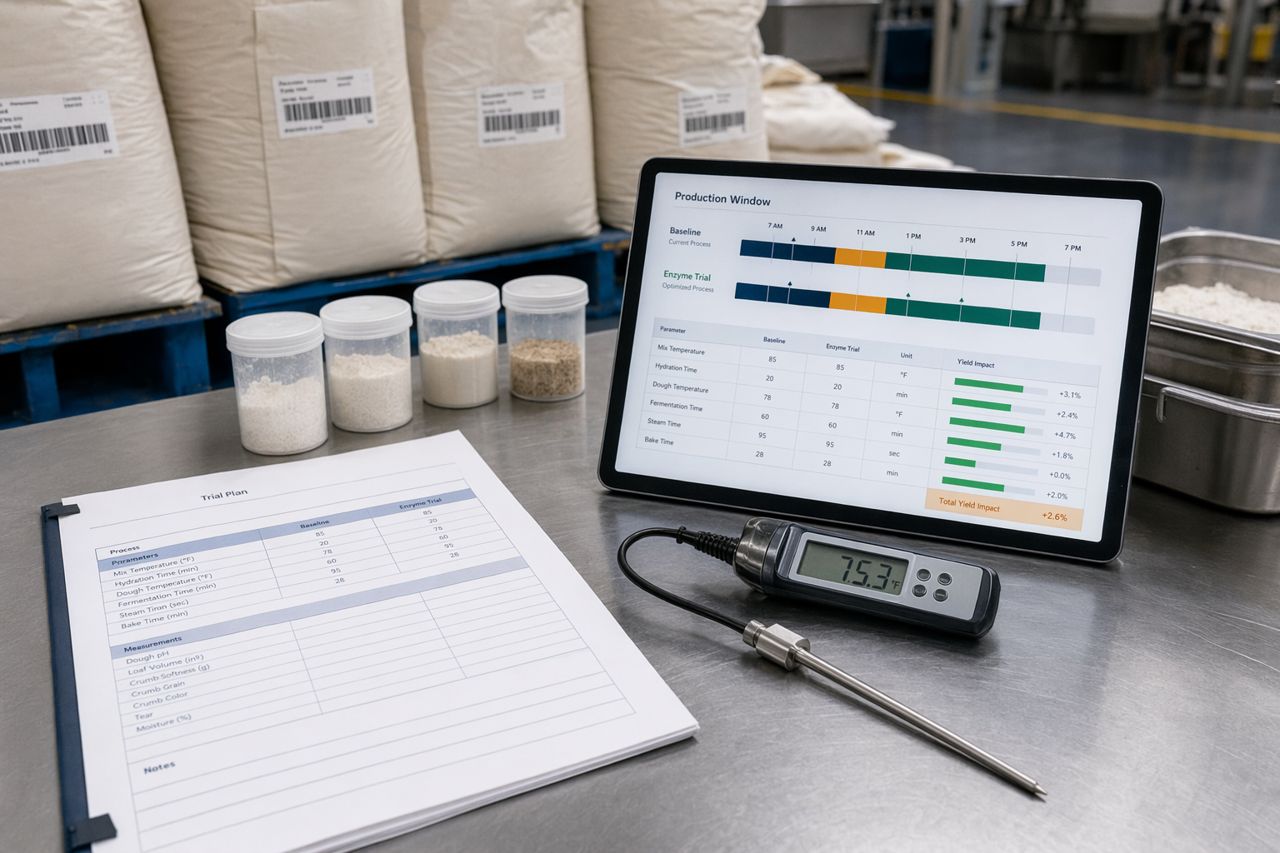
An enzyme-enabled replacement may have different needs around contact time, mixing, temperature profile, or pH adjustment. If the trial is run during an unusually quiet production window, it may fail to reveal scheduling constraints that appear during normal operation.
When selecting a production window, consider:
- Line speed and throughput pressure
- Shift coverage and operator familiarity
- Availability of quality testing support
- Cleaning or changeover timing
- Storage and hold-time limits
- Downstream process sensitivity
- Maintenance activity near the line
- Ability to isolate trial material if needed
A good trial window is controlled, but not artificial. It should allow the team to measure the enzyme process without hiding the plant realities that determine adoption.
Use paired comparisons where possible
Where production logistics allow, pair the enzyme trial with a comparable chemical-control batch.
A paired comparison may use:
- Same raw material supplier and lot family
- Similar production timing
- Same equipment route
- Similar batch size
- Same downstream quality checks
- Same operator shift or equivalent coverage
This reduces the risk of attributing normal process variation to the enzyme change.
In many factories, perfect pairing is not possible. That is acceptable. The important step is to document differences clearly so the trial review can separate process effect from background noise.
Decide which KPIs will determine success
Batch selection should be tied to measurable KPIs before the trial starts.
Typical KPI categories include:
- Yield or recovery
- Conversion or processing completeness, expressed in plant-relevant terms
- Cycle time or hold time
- Rework frequency
- Product quality release parameters
- Downstream filtration, separation, or handling behavior
- Chemical reduction or elimination at the target step
- Wastewater or effluent load where directly measured by the plant
- Cleaning time or changeover impact
- Operator interventions
- Cost per finished unit or per production batch
Avoid changing success criteria after seeing the result. If the trial is expected to support a replacement decision, the approval gates should be agreed in advance.
A practical structure is:
- Must pass: safety, quality release, and regulatory or customer requirements
- Should improve: chemical use, yield, cycle time, rework, or cost
- Must not worsen: downstream operations, cleaning burden, line availability, or operator workload beyond agreed limits
Build a batch selection matrix
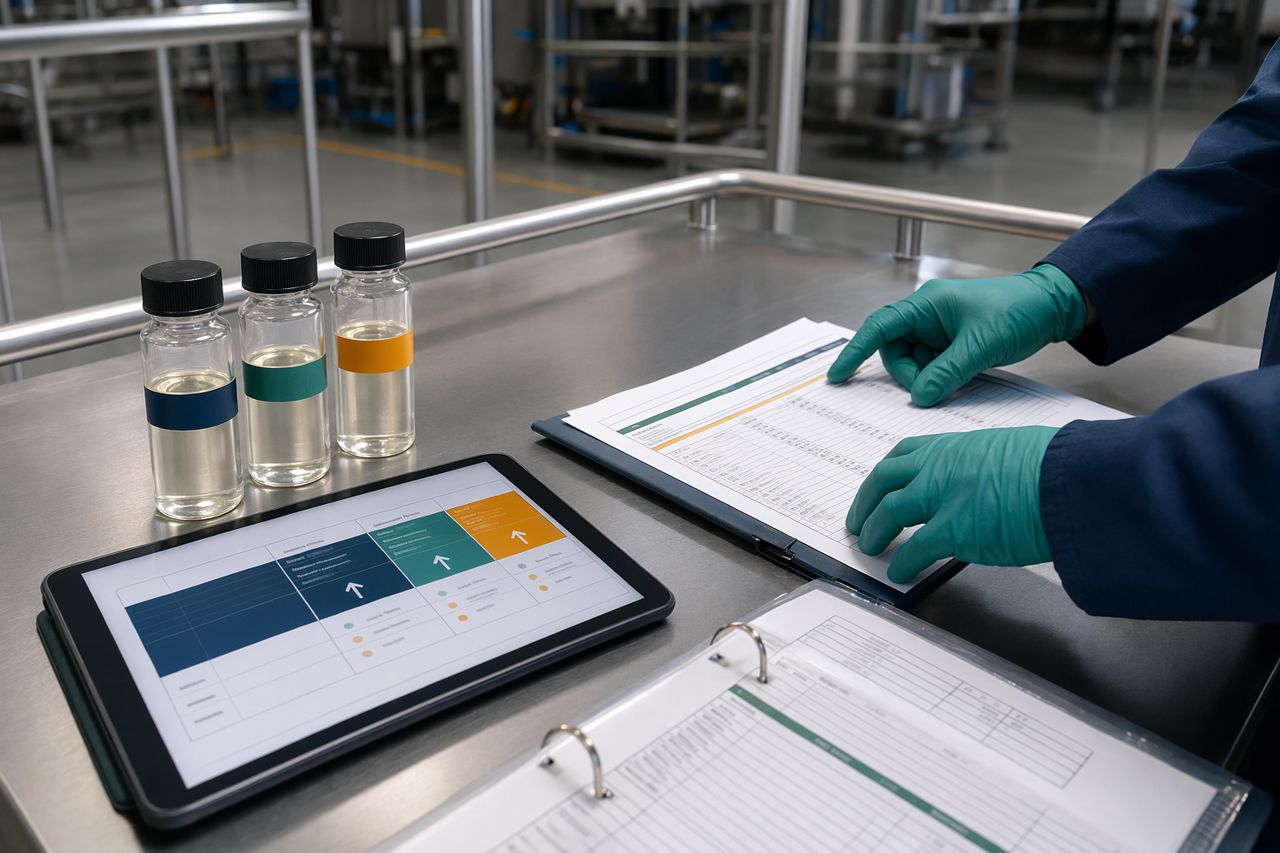
A simple matrix helps prevent subjective trial selection.
Example batch selection fields
| Field | Why it matters |
|---|---|
| Raw material source | Captures supplier-related variation |
| Material condition | Indicates typical, high-load, seasonal, or challenge case |
| Batch size | Confirms relevance to production mixing and residence time |
| Equipment route | Links results to actual implementation constraints |
| Production window | Records shift, schedule pressure, and support availability |
| Chemical baseline match | Shows whether comparison is direct or approximate |
| Quality checks | Confirms release criteria and downstream impact are measured |
| Risk controls | Defines hold, isolation, fallback, and stop conditions |
| Decision gate | Connects the batch to a go/no-go or optimization question |
The matrix does not need to be complex. Its value is discipline: every selected batch should have a clear reason for inclusion.
Plan for fallback before the trial begins
Chemical replacement trials should include defined fallback routes. This protects production and gives plant teams confidence to run the test properly.
Fallback planning may include:
- Maximum hold time before reverting to the current process
- Criteria for adding the existing chemical step if needed
- Segregation plan for trial material
- Additional quality checks before downstream release
- Escalation contact for process, quality, and operations teams
- Stop conditions linked to product safety, equipment risk, or quality deviation
A controlled fallback plan is not a sign of low confidence. It is a requirement for responsible factory validation.
Do not overfit the trial to the enzyme recommendation
A frequent mistake is choosing trial conditions that match the enzyme recommendation perfectly but do not match the plant.
For example, a lab recommendation may indicate a preferred temperature or contact window. If the plant can only reach that window intermittently, the trial should test the plant-relevant condition, not only the ideal condition.
The right question is not, “What condition makes the enzyme look best?”
The right question is, “What operating envelope can the factory run repeatedly, and does the enzyme process perform inside it?”
This is where trial design, production knowledge, and commercial judgment need to meet.
How many batches are enough?
There is no universal number. The right number depends on process risk, raw material variability, production value, quality sensitivity, and the cost of disruption.
As a practical starting point, many factories benefit from a staged approach:
Stage 1: Controlled confirmation
Use one representative batch or pilot-equivalent production run to confirm the proposed enzyme process can operate in the plant environment.
Stage 2: Representative comparison
Run one or more comparable batches against the current chemical process, using agreed KPIs and documented raw material conditions.
Stage 3: Variation challenge
Test a defined source of normal variation, such as seasonal material, a different supplier lot, or a higher-load condition within specification.
Stage 4: Operating envelope validation
Confirm the process across the conditions needed for routine scheduling, including realistic shift timing, batch size, and downstream handling.
This staged structure prevents the team from taking excessive risk too early while still moving toward production-level proof.
What a strong trial record should include
A useful trial record should allow a cross-functional team to review the result without relying on memory.
Include:
- Batch selection rationale
- Baseline batch details
- Raw material and supplier details
- Process parameters actually achieved
- Deviation notes
- Operator observations
- Sampling points and quality results
- KPI comparison against the agreed baseline
- Photos or line notes where useful
- Decision gate outcome
- Recommendation for repeat, optimize, scale, or stop
The trial record should show not only whether the enzyme-supported process worked, but under what conditions it worked.
Common batch selection mistakes to avoid
Choosing the easiest batch first and calling it proof
An easy batch can be a useful first confirmation, but it should not carry the whole replacement decision.
Trialing during an unrealistic production window
If the process only works when the line is quiet, the adoption case may be weak.
Ignoring raw material variability
Enzyme performance can be sensitive to substrate condition and interfering materials. If the plant sees variation, the trial must account for it.
Using incomplete baseline data
Without a current baseline, the trial result may be interpreted incorrectly.
Measuring only the target step
A chemical replacement can affect downstream separation, cleaning, quality release, or rework. Measure the full production impact.
Failing to define stop conditions
Factories need clear boundaries before trial execution. Ambiguity increases operational risk.
The practical path from recommendation to validation
A good enzyme trial is not a lab demonstration repeated at larger scale. It is a controlled production exercise designed around factory constraints.
For chemical replacement projects, representative batch selection should answer four questions:
- Does the enzyme process work on normal material?
- Does it hold up against expected variation?
- Does it fit the actual production window?
- Does it improve the commercial KPI without creating new operating risk?
When those questions are built into trial design, plant teams get a clearer basis for decision-making.
Request a quote for a structured factory enzyme trial
Yieldwright Labs supports factories with enzyme trial planning, batch selection logic, KPI definition, and production-floor validation pathways for chemical step replacement projects.
If you are evaluating an enzyme-enabled replacement for an existing chemical process, share your process context, target step, current constraints, and desired production outcome through the on-site request a quote form. We will respond with a practical trial scope aligned to your plant conditions.